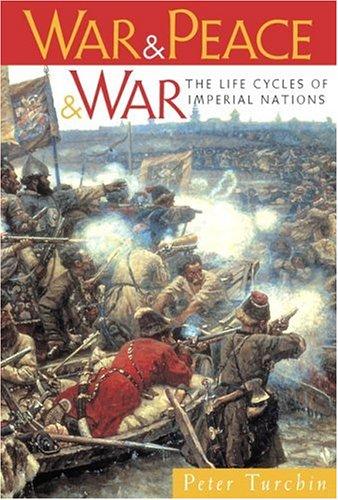
Turchin is trying to do something that most historians would tell you can’t be done, find actual predictive patterns in why empires rise and collapse, and he builds the whole case around a borrowed concept called asabiya, roughly social cohesion or the capacity of a group to act collectively, which he argues gets forged hardest at frontier zones where cultures grind against each other under pressure. Russian expansion, the Roman frontier, the long English-French conflict, he walks through all of it hunting for the same underlying mechanism.
I went in skeptical, partly because I remember reading that a serious philosopher of science more or less proved prediction in this sense is impossible for social systems, and Turchin himself seems to know this criticism is coming, he hedges more than once about how complete his conclusions can really be. That honesty bought him a lot of goodwill from me even where I wasn’t fully convinced. The book reads less like a finished theory than an argument still being built in real time, informal in the way a great lecture is informal, which works for the material even if it means some claims land softer than others.
My one real complaint matches what I’ve seen elsewhere, the European examples dominate and the non-European empires get comparatively thin treatment, which weakens a book whose whole premise is supposed to be universal. Still, asabiya is one of those ideas that’s stuck with me in ways I didn’t expect, I catch myself applying it to completely unrelated situations, a company culture, a gaming group even, wherever cohesion under shared pressure seems to be doing real work. That’s a good sign for a history book to leave you with.